

Key Takeaways
- Reinsurance bordereaux are one of the most operationally intensive and error-prone processes in insurance back-office administration — and in most legacy environments, they are still produced manually in spreadsheets.
- The cost of manual bordereaux production is not just operational — it is financial: errors in ceded premium bordereaux result in incorrect reinsurer billing, disputes, and delayed recoveries.
- Bordereaux automation requires direct data integration between the reinsurance module and the policy, accounting, and claims systems — not a separate export-and-reconcile workflow.
- CLAPi©'s Reinsurance module generates bordereaux automatically from the platform's policy, accounting, and claims data, with configurable output formats for each reinsurer's submission requirements.
Ask any reinsurance operations manager in a mid-sized insurer how their bordereaux are produced, and the answer is almost always some version of the same story.
Policy data is exported from the core system at month-end. Premium data is pulled from the accounting system. Claims data comes from a third extract. Someone in the reinsurance team spends two to three days reconciling these three exports in Excel, checking for policies that appear in one extract but not another, applying treaty terms manually to calculate ceded premium, and formatting the output to each reinsurer's preferred layout.
Then the review cycle begins. Errors are found. The process repeats. The bordereaux goes out late. The reinsurer queries a line item. The process repeats again.
This is not a niche problem. It is the standard operating model for reinsurance bordereaux production in the majority of insurance companies that run legacy core systems. And it carries a cost that most insurers have never fully quantified.
What Is a Reinsurance Bordereaux and Why Does It Matter?
A bordereaux is a periodic data submission from an insurer to its reinsurer, summarising the business ceded under a reinsurance treaty during the reporting period. Bordereaux come in two primary forms:
- Premium bordereaux — detailing the policies ceded, the ceded premium for each policy, and the reinsurer's share of that premium.
- Claims bordereaux — detailing the claims on ceded policies, the reinsurer's share of each claim, and the status of recovery.
Bordereaux are the operational basis of the reinsurance relationship. Reinsurers use them to reconcile their assumed business, calculate their liability, and settle accounts with the cedant. Errors in bordereaux create disputes, delay settlement, and damage the reinsurance relationship.
The frequency of bordereaux varies by treaty — monthly, quarterly, or annually — but the operational burden of producing them is consistent regardless of frequency: data must be extracted, reconciled, calculated, formatted, and submitted.
The Real Cost of Manual Bordereaux Production
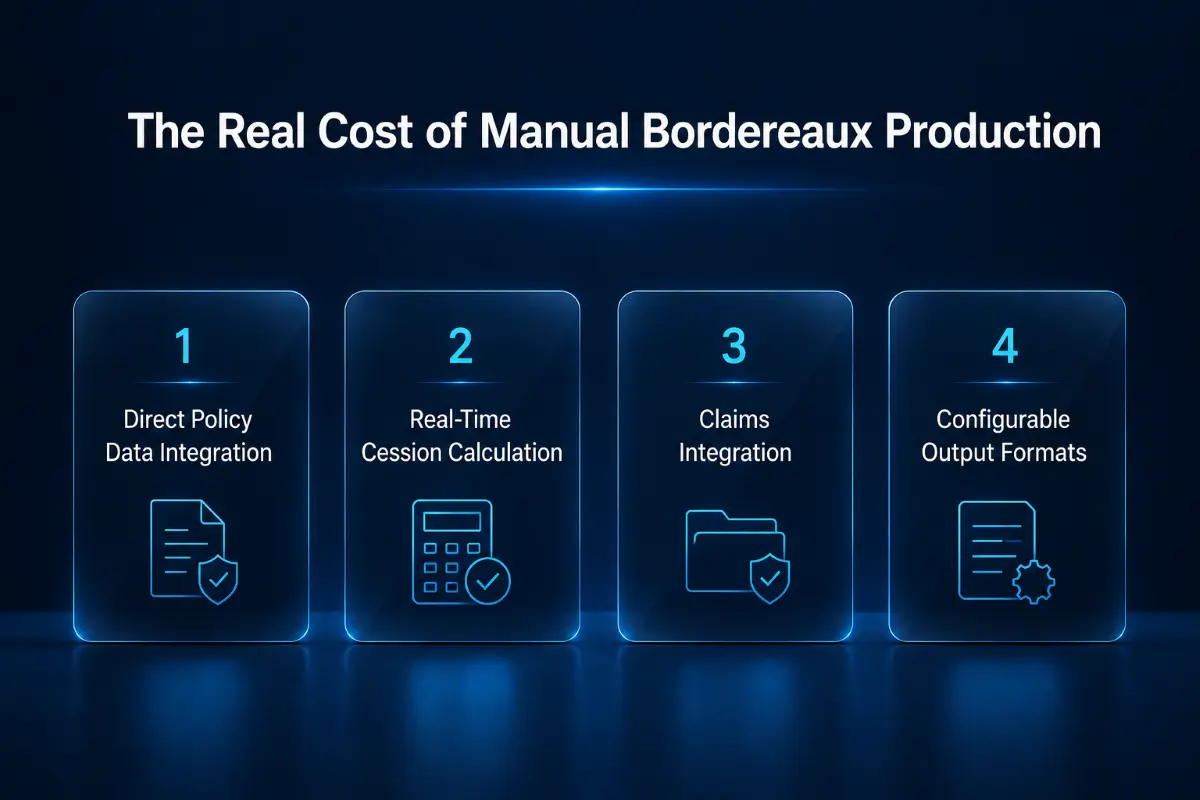
Genuine bordereaux automation is not a reporting tool layered on top of a manual process. It requires the reinsurance module to have direct, real-time access to the insurer's policy, accounting, and claims data — so that bordereaux are generated from live system data rather than from period-end extracts.
The specific requirements are:
-
Direct policy data integration
The reinsurance module must have access to the full policy record — sum insured, benefit structure, effective dates, endorsements — at the point of cession calculation, not from a period-end extract that may not reflect mid-term changes.
-
Real-time cession calculation
Cession must be calculated at the point of policy issuance and updated automatically when policies are endorsed or cancelled. The bordereaux is then a report of already-calculated cessions, not a calculation exercise performed at month-end.
-
Claims integration
Claims bordereaux require access to the full claims record — date of loss, benefit category, gross amount, settlement status — from the claims management system. Without direct integration, claims data must be extracted separately and reconciled with the policy and cession data.
-
Configurable output formats
Different reinsurers have different bordereaux format requirements. The automation system must generate bordereaux in each reinsurer's required format without manual reformatting.
How CLAPi© Automates Reinsurance Bordereaux
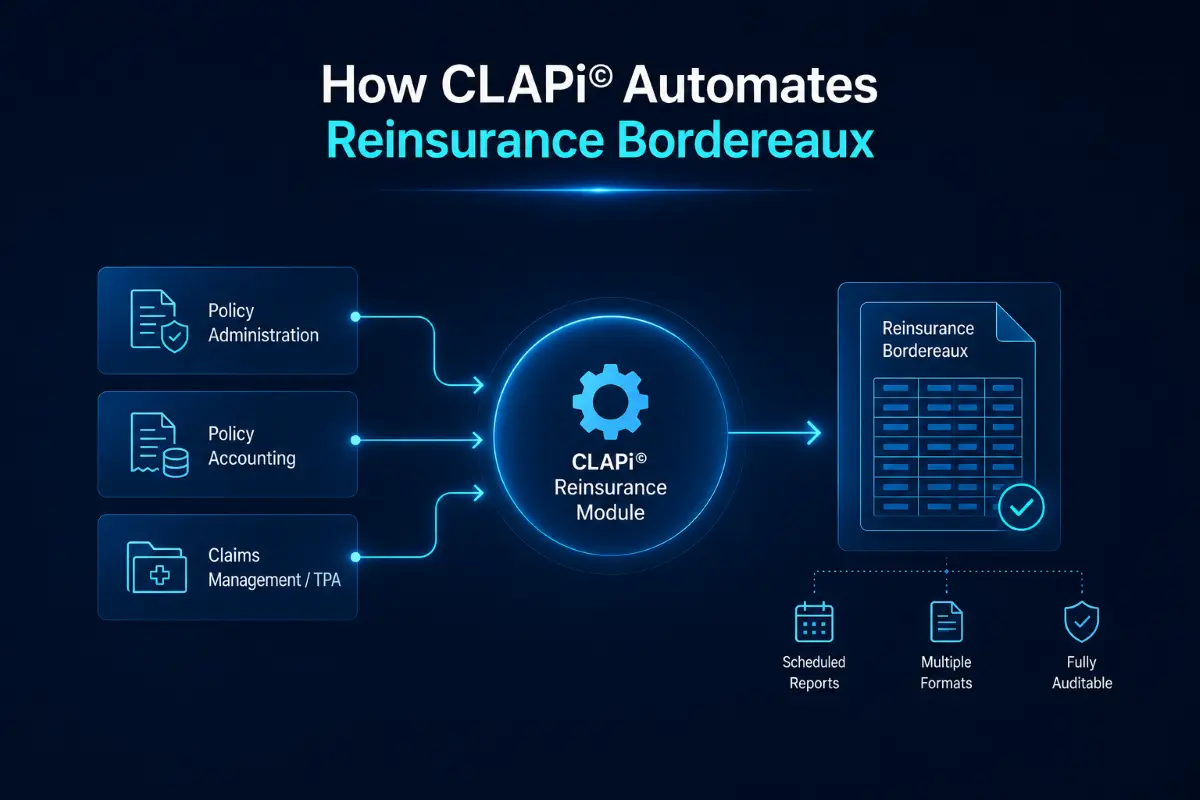
CLAPi©'s Reinsurance module generates bordereaux automatically because it shares the same data layer as Policy Administration, Policy Accounting, and Claims Management / TPA. There is no extraction, no reconciliation, and no manual step between the operational data and the bordereaux output.
When a policy is issued in CLAPi©'s Policy Administration module, the cession is calculated immediately against the applicable treaty and recorded in the Reinsurance module's ledger. When a claim is processed in Claims Management, the reinsurer's share is calculated automatically and added to the claims cession record. The bordereaux is generated from these already-calculated records, in the reinsurer's required format, on the configured reporting schedule.
The result is a bordereaux process that requires no manual intervention, produces output that is always consistent with the insurer's own policy and claims records, and is fully auditable — every bordereaux line item traces directly to the source policy or claim record in the system.
FAQs
A reinsurance bordereaux is a periodic data submission from an insurer to its reinsurer summarising the business ceded under a treaty during the reporting period. Premium bordereaux cover ceded policies and premiums; claims bordereaux cover claims on ceded policies and reinsurance recoveries. Bordereaux are the operational basis of reinsurance accounting and settlement.
Most legacy insurance core systems do not have native reinsurance modules that share data directly with the policy and claims systems. Without this integration, bordereaux production requires extracting data from multiple systems and reconciling it manually — a process that persists because the platform architecture makes automation difficult to implement.
Bordereaux automation requires the reinsurance module to have direct, real-time access to policy, accounting, and claims data — so that cessions are calculated at the point of policy issuance and claims processing, and the bordereaux is a report of already-calculated records rather than a period-end calculation exercise. CLAPi©'s native Reinsurance module achieves this through direct data integration within the same platform.
CLAPi©'s Reinsurance module generates bordereaux with configurable output formats, allowing the platform to produce submissions in each reinsurer's required format without manual reformatting. Because the data is drawn directly from the platform's operational records, the output is always consistent with the insurer's own data and audit-ready.
Automate Your Reinsurance Bordereaux with CLAPi©
If you want to understand how CLAPi©'s native Reinsurance module eliminates manual bordereaux production and integrates directly with your policy and claims data, our team can walk you through a live demonstration.
Request a demo at enoviq.com/platform/group-insurance